What to See in Death Valley
The must-see stops in Death Valley on a day trip from Las Vegas — Badwater Basin, Zabriskie Point, Mesquite Flat Dunes, Artists Palette, Furnace Creek and Dante's View.
Death Valley is enormous — the largest national park in the contiguous United States — but its greatest hits cluster within reach of a single day from Las Vegas. The trick is knowing which stops are unmissable, which are quick photo pulls, and how they fit together. This guide walks through the headline sights a good day tour threads together. For the tours that visit them, start on the home page.
The Park’s Defining Range: Lowest to Highest
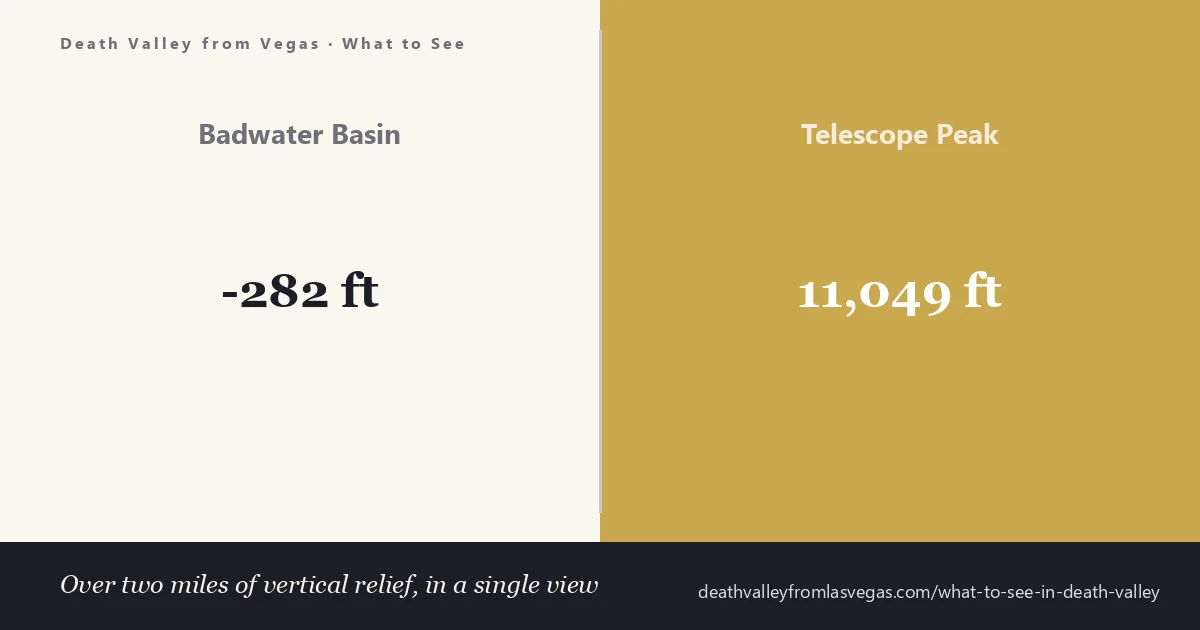
The single fact that frames everything is Death Valley’s vertical extreme. The valley floor at Badwater Basin sits 282 feet (86 m) below sea level — the lowest point in North America — while Telescope Peak rises to 11,049 feet (3,368 m) on the western wall, often snow-capped in winter. That’s more than two miles of vertical relief within sight of each other: you can stand on the salt and look straight up at snow. No other stop captures the park’s character better than that contrast, and it’s why Badwater is almost every itinerary’s anchor.
Badwater Basin — The Lowest Point in North America
Walk out from the boardwalk onto the salt flats and you’re on the floor of the continent. The white crust stretches for nearly 200 square miles, cracking into hexagonal polygons where the ground is firm. Look back at the cliff behind the parking area and you’ll spot a small “Sea Level” sign high on the rock — a vivid measure of just how far below it you’re standing. It’s the park’s signature photo and a genuinely strange place to stand.
Zabriskie Point — Golden Badlands
A short drive away, Zabriskie Point overlooks a maze of eroded, wind-carved badlands that glow gold at sunrise and sunset. It’s a five-minute walk from the parking area to the overlook, which makes it one of the highest-reward, lowest-effort stops in the park — and a favourite for both first light and golden hour.
Mesquite Flat Sand Dunes — Walkable Dunes
Near Stovepipe Wells, the Mesquite Flat Sand Dunes are the easiest dunes in the park to walk into, rising in smooth, rippled crests right beside the road. They’re spectacular at dawn and dusk when low light rakes across the sand. You can wander as far in as you like, but even a short stroll from the car gets you the classic dune shot.
Artists Palette & Dante’s View — Color and Panorama
Two more stops round out the classics. Artists Palette, reached by a one-way scenic drive, is a hillside streaked with greens, pinks, and purples from oxidized metals in the volcanic rock — best in the softer afternoon light. Dante’s View, perched at about 5,475 feet on the valley’s eastern rim, delivers the grand panorama: the entire Badwater basin laid out far below, with the snow-capped Panamint Range beyond. It’s cooler up there, so it’s a welcome stop on a hot day.
Furnace Creek & the Rhyolite Add-On
Furnace Creek is the park’s hub — home to the visitor center, the historic ranch, and the spot that holds the world heat record. It’s where many tours pause for facilities, water, and context. Some itineraries also pair the park with Rhyolite ghost town, just over the Nevada line near Beatty — a gold-rush boomtown that swelled and emptied in barely a decade in the early 1900s, now a scatter of ruins beside an open-air sculpture park.
The Stops at a Glance
| Stop | What it is | Effort |
|---|---|---|
| Badwater Basin | Salt flats, -282 ft (lowest in N. America) | Short flat walk |
| Zabriskie Point | Golden eroded badlands overlook | 5-min walk |
| Mesquite Flat Dunes | Walkable sand dunes near Stovepipe Wells | Stroll as far as you like |
| Artists Palette | Mineral-streaked colored hills (scenic drive) | Drive + short stops |
| Dante’s View | Panorama of the basin from ~5,475 ft | Roadside overlook |
| Furnace Creek | Visitor center + park hub | Facilities stop |
| Rhyolite (add-on) | Early-1900s gold-rush ghost town | Short walk |
Exact stops vary by operator and the day’s conditions — heat, wind, and the occasional flash-flood road closure all factor in. A standard full-day tour hits the core of this list; sunset and stargazing tours trade some daytime stops for golden hour and dark skies.
Plan the Rest of Your Day
Knowing the stops is half the job; timing is the other half. The mildest light and air come October through April — see the best time to visit Death Valley from Las Vegas — and the logistics of getting between the city and these sights are in how far Death Valley is and how to get there. Wondering if it’s worth the day at all? Read is a Death Valley day trip worth it.
Ready to Book?
A good guided day links these stops in a sensible order with the driving and timing handled. Compare the tours on the home page, each with free cancellation up to 24 hours before, then check availability for your dates.
See Death Valley from Las Vegas — Book Your Day Trip
From a classic full-day tour to a sunset-and-stargazing run, hotel pickup, park entrance fees, water and a guide who knows the heat are all included — and you can cancel free up to 24 hours before.
Check Availability & Book